
Difficult-Alloy Precision CNC Machining
Precision Semiconductor CNC Machining Services
Semiconductor equipment requires components that perform flawlessly in vacuum environments, high temperatures, and corrosive chemical processes. A single out-of-tolerance feature or undocumented material swap can compromise an entire wafer fabrication line.
At AXALLOY Precision, we provide semiconductor CNC machining services focused on complex geometries, difficult-to-machine alloys, and strict process control. We support engineering, procurement, and quality teams from initial prototype development through low-volume and controlled repeat production.
When you partner with us, you secure a manufacturing route built on manufacturability, transparent communication, and comprehensive documentation.
What You Gain When Partnering With AXALLOY
We understand that semiconductor OEMs and Tier 1/Tier 2 suppliers evaluate total supply risk, not just the lowest unit price. Here is how our machining approach directly supports your project goals:
Faster Validation Through Proactive DFM
We don't just say we offer fast turnaround times. We actually accelerate your development cycle by conducting thorough drawing reviews and Design for Manufacturing (DFM) feedback before we cut any metal.
By identifying tolerance conflicts, difficult internal radii, or fixturing challenges early, we prevent costly rework. This means your engineering prototypes arrive on schedule, allowing you to validate designs and move to production faster.
Predictable Assembly for Critical Interfaces
Semiconductor components like vacuum chambers, manifolds, and wafer handling arms require perfect mating surfaces to prevent leaks and contamination.
With 5-axis milling and precision grinding capabilities, we deliver position tolerances down to 0.010 mm and flatness down to 0.005 mm. You receive parts that fit together exactly as designed, eliminating assembly-line adjustments.
Simplified Quality Compliance
Your quality engineers need proof, not promises. We provide complete transparency for every batch.
You receive comprehensive documentation packages, including Material Test Reports, First Article Inspection (FAI) reports, full dimensional CMM data, and special process records. This ensures your components meet strict semiconductor traceability requirements right out of the box.
Expertise in Difficult Alloys
Etch and CVD processes demand highly corrosion-resistant and heat-resistant materials.
We specialize in machining the exact alloys required for harsh semiconductor environments, including Hastelloy, Inconel, Titanium, and precipitation-hardening stainless steels, ensuring your parts survive their intended lifecycle.
Core Machining Capabilities for Semiconductor Components
We evaluate material behavior, geometry, tolerances, surface requirements, and production volume before defining the machining process for your semiconductor parts.
Multi-Axis CNC Milling
3-axis, 4-axis, and 5-axis machining for complex vacuum chambers, showerheads, and thin-walled structural components.
Precision CNC Turning & Mill-Turn
Combining operations to require fewer setups, ensuring stronger feature relationships for gas delivery nozzles, precision shafts, and valve bodies.
Wire & Sinker EDM
Achieving sharp internal corners, narrow slots, and complex internal profiles that traditional cutting tools cannot reach.
Precision Grinding & Surface Finishing
Delivering ground surface finishes down to Ra 0.2 μm for critical sealing surfaces and bearing fits.
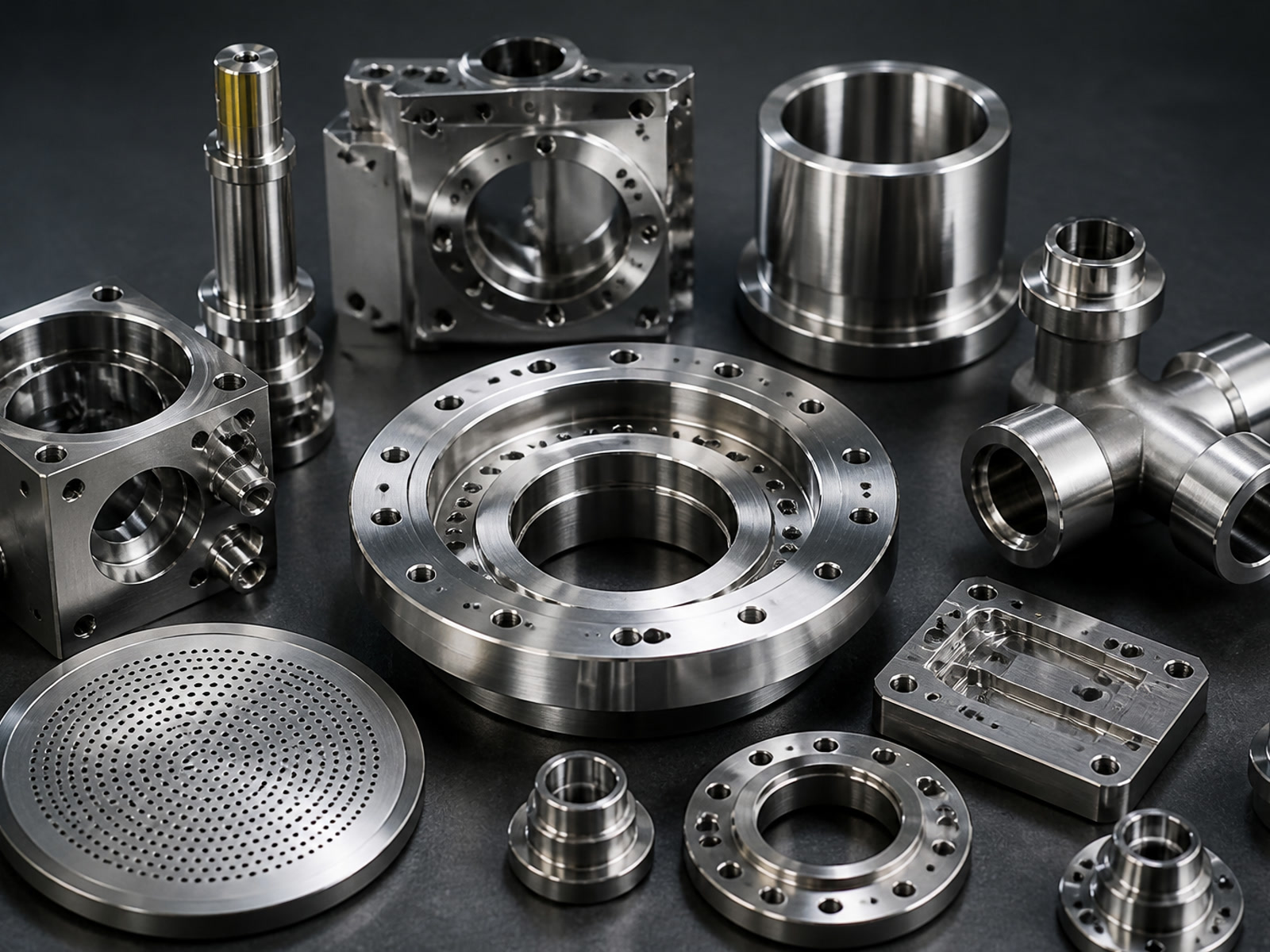
Materials for Semiconductor Applications
We routinely machine the high-performance metals required for semiconductor manufacturing equipment:
Corrosion-Resistant Alloys
- Hastelloy C-276 / C-22
- Monel 400 / K-500
High-Temperature Superalloys
- Inconel 718
- Inconel 625
- Inconel 600
Titanium Alloys
- Grade 2
- Grade 5
- Grade 23
Stainless Steels
- 316L, 304
- 17-4 PH
- 15-5 PH
Specialty Metals
Molybdenum, Tungsten, Nitronic 50/60
Technical Specifications & Tolerances
Below are our standard and precision capabilities to help your engineering team assess our fit for your next project.
General Machining Capabilities
| Parameter | Standard Capability |
|---|---|
| Supported Production Volume | 1–10,000+ parts |
| Prototype Quantity | 1–20 parts |
| Precision Dimensional Tolerance | ±0.005 mm |
| Position Tolerance | Down to 0.010 mm |
| Flatness | Down to 0.005 mm |
| Concentricity | Down to 0.008 mm |
| Precision Machined Finish | Ra 0.8 μm |
| Ground Surface Finish | Down to Ra 0.2 μm |
| Minimum Wall Thickness | 0.5 mm |
| Minimum Machined Hole Diameter | Ø0.5 mm |
CNC Milling (3, 4, and 5-Axis)
| Parameter | Standard Capability |
|---|---|
| Maximum 5-Axis Part Size | Ø500 × 400 mm |
| Maximum 3-Axis Part Size | 1,000 × 600 × 600 mm |
| Positioning Accuracy | ±0.005 mm |
| Repeatability | ±0.003 mm |
| Minimum Internal Corner Radius | R0.3 mm |
| Suitable Parts | Housings, brackets, manifolds, plates, complex structural components |
Mill-Turn Machining
| Parameter | Standard Capability |
|---|---|
| Machining Configuration | Main spindle, sub-spindle, C-axis, Y-axis, live tooling (up to 9 axes) |
| Maximum Machining Diameter | Ø400 mm |
| Maximum Machining Length | 800 mm |
| Typical Tolerance | ±0.008 mm |
| Suitable Parts | Complex shafts, valve bodies, connectors, multi-feature rotational components |
Inspection & Quality Control
| Parameter / Documentation | Availability / Capability |
|---|---|
| CMM Measuring Range | 700 × 1,000 × 600 mm |
| CMM Accuracy | Up to 1.8 + L/300 μm |
| Material Test Report / Mill Cert | Available |
| First Article Inspection (FAI) | Available |
| Full Dimensional Report | Available |
| Material & Lot Traceability | Available |
| Inspection Environment | Temperature-controlled inspection room |
Start Your Semiconductor Machining Project
If you are dealing with complex geometries, high-value prototypes, or are transferring a critical project from an unreliable supplier, AXALLOY Precision is ready to review your requirements.
We provide detailed, technical quotes that address manufacturability, material requirements, and your specific documentation needs.
To get an accurate quote within our standard lead times, please provide:
- 1 3D CAD Files (STEP, STP, IGES, IGS, X_T, SLDPRT)
- 2 2D Drawings (PDF, DWG, DXF) with defined tolerances and critical features identified
- 3 Material requirements and expected quantities
- 4 Required quality documentation (e.g., FAI, Material Certs)
Request a Technical Quote
Request a Quote
Tell us about your component requirements and material challenges.