
Difficult-Alloy Precision CNC Machining
Protective Coating for Precision CNC Machined Parts (Difficult Alloys)
When you machine parts from nickel alloys, titanium, duplex stainless, or precipitation-hardening stainless, the coating step is often where performance and documentation either come together—or fall apart. At AXALLOY Precision (Shenzhen), we support your project from machining through protective coating and the related quality records, so your parts arrive ready for assembly, validation testing, or repeat production.
If you're preparing an RFQ, send us your drawing/model plus coating requirements (or the operating environment). We'll respond with a manufacturable route, inspection approach, and documentation list.
What you get when coating is planned with machining (not added later)
Integrating protective coating into the machining workflow from day one eliminates costly surprises and keeps quality documentation aligned across every process step.
Fewer rework loops caused by coating-driven fit changes
Coatings can change functional dimensions, surface texture, and thread behavior. We review:
- •Critical fits and sealing surfaces
- •Threaded features and tapped holes
- •Masked areas and electrical contact surfaces
- •Edge breaks and burr-control points
What you get: fewer "parts don't assemble after coating" issues, and clearer acceptance criteria before production starts.
Better corrosion and wear protection matched to real service conditions
Instead of quoting a coating in isolation, we align the coating with:
- •Base material behavior (e.g., titanium, Inconel, 17-4PH, duplex)
- •Temperature exposure, corrosion media, salt fog risk
- •Wear points, sliding contact, galling risk
- •Cosmetic vs. functional surfaces
What you get: a protective coating choice that is more likely to pass validation the first time, reducing test delays and redesign cycles.
Clean handoff for quality teams: certificates and traceability
For many aerospace, medical, energy, and semiconductor projects, the coating is not "just a finish"—it's a controlled process step.
What you get (as required):
- •Material and lot traceability
- •Certificates of Conformance (CoC)
- •First Article Inspection (FAI) and dimensional reports
- •Coating certificates / special process records
- •Surface roughness reporting when needed
Faster programs because machining + coating are scheduled as one plan
"Fast" only matters if it removes downstream risk. We coordinate machining, deburring, cleaning, coating, and final inspection so you don't lose weeks to:
- •Waiting for external coating slots after machining is done
- •Re-cleaning due to handling contamination
- •Repeat inspection caused by unclear acceptance standards
What you get: shorter time from RFQ to usable parts for EVT/DVT builds, supplier requalification, or urgent line-down replacements.
Typical coated parts we support
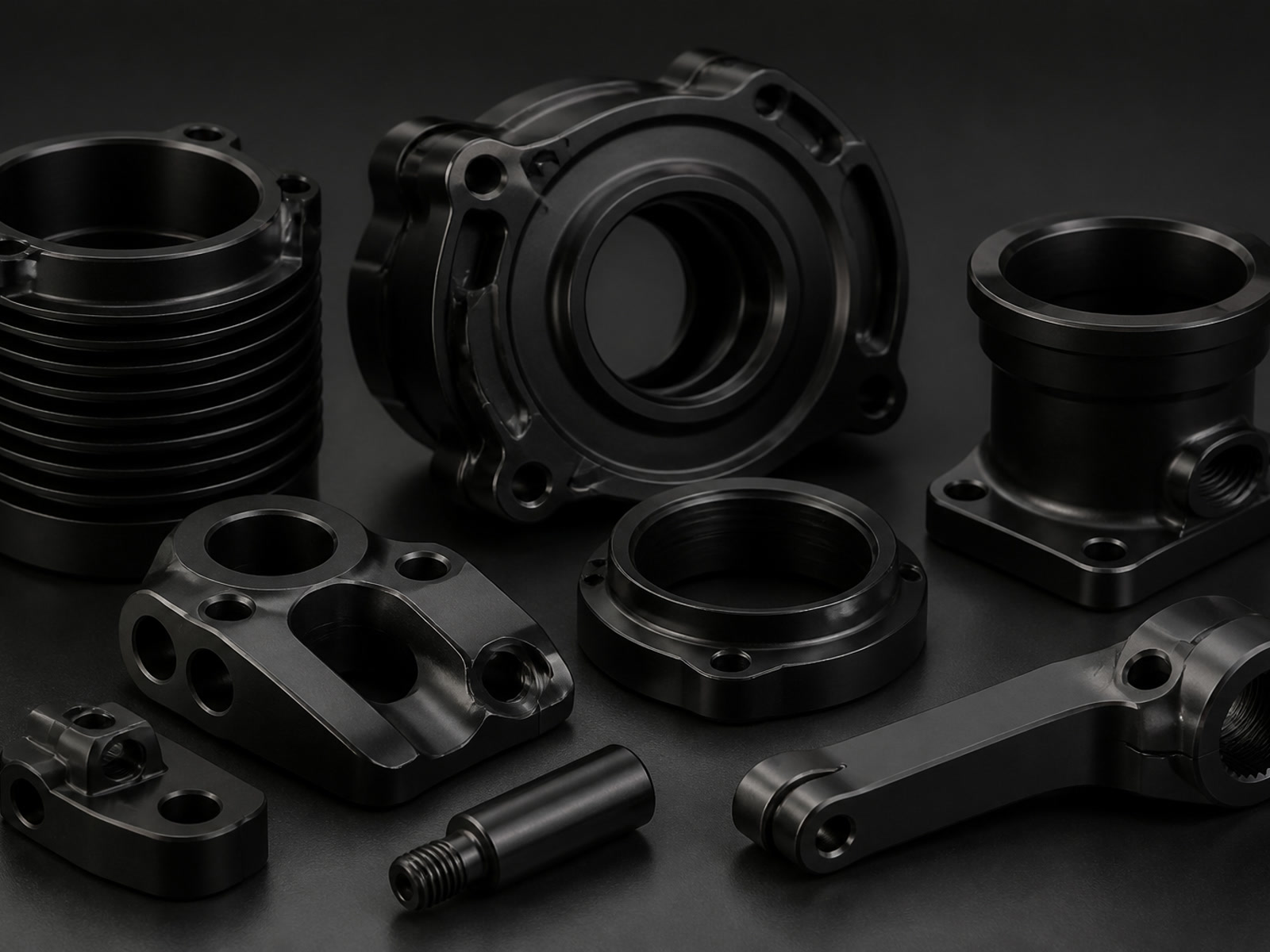
- •Housings, brackets, manifolds, plates, complex structural components
- •Shafts, sleeves, bushings, valve parts, threaded components
- •Thin-wall and tight-tolerance components where masking and edge control matter
Materials we frequently coat after machining include:
How we quote Protective Coating (what to include in your RFQ)
To quote accurately and avoid change orders, we recommend you provide:
-
1
2D Drawing + 3D Model
STEP/STP preferred
-
2
Material Grade & Condition
Heat treat status if specified
-
3
Coating Spec
Standard, thickness range, color, masking notes
-
4
Critical Features List
Fits, sealing areas, threads, datum scheme
-
5
Quantity & Delivery Target
Prototype vs. repeat batch
-
6
Required Documentation
FAI, full dimensional, coating cert, etc.
Don't have a final coating call yet?
Tell us the environment (corrosion media, temperature, wear/contact). We'll feedback what information is still needed to lock the process.
Capabilities snapshot (machining + coating-ready finishing)
General Capability (Selected)
| Supported production volume | 1–10,000+ parts |
| Minimum order quantity | 1 part |
| Standard dimensional tolerance | ±0.010 mm |
| Precision dimensional tolerance | ±0.005 mm |
| Position tolerance | down to 0.010 mm |
| Flatness | down to 0.005 mm |
| Concentricity | down to 0.008 mm |
| Standard surface finish | Ra 1.6 μm |
| Precision machined finish | Ra 0.8 μm |
| Ground surface finish | down to Ra 0.2 μm |
| Standard lead time | 10–20 business days |
| Prototype lead time | 5–10 business days |
| Expedited service | available |
| Accepted units | metric & imperial |
CNC Milling (Selected)
| 3/4/5-axis milling | supported |
| Max 3-axis part size | 1,000 × 600 × 600 mm |
| Positioning accuracy | ±0.005 mm |
| Repeatability | ±0.003 mm |
| Milling tolerance | down to ±0.005 mm |
| Min internal corner radius | R0.3 mm |
| Minimum wall thickness | 0.5 mm |
Turning / Mill-Turn (Selected)
| Max turning diameter | Ø500 mm |
| Turning tolerance | down to ±0.005 mm |
| Concentricity | down to 0.008 mm |
| Mill-turn axes | up to 9 axes |
| Typical mill-turn tolerance | ±0.008 mm |
Inspection & Documentation (Selected)
| CMM range | 700 × 1,000 × 600 mm |
| CMM accuracy | up to 1.8 + L/300 μm |
| Optical measurement accuracy | ±0.002 mm |
| Surface roughness measurement | Ra 0.05–40 μm |
| FAI / full dimensional | available |
| Material test report / MTC | available |
| Coating certificate | available |
| Traceability | available |
Protective coating: what we control before parts leave our hands
Even when a coating is specified, the success depends on upstream controls:
Deburring strategy
Prevents edge breakout after coating
Cleaning and handling
Reduces adhesion failures and staining
Masking and feature protection
For threads, sealing faces, and datum interfaces
Final inspection timing
Dimensions verified pre- and/or post-coating as your spec requires
What you get: a coating result that supports assembly, testing, and repeatability—not just a visually coated surface.
Request an RFQ
We'll respond with a process + documentation plan.
- •STEP/STP + PDF drawing
- •Material and quantity
- •Coating spec (or service environment)
- •Required certificates (FAI, full dimensional, coating cert, traceability)
File formats supported: STEP, STP, IGES, X_T, SLDPRT, SAT, PDF, DWG, DXF
Max upload: 500 MB per RFQ
Request a Quote
Tell us about your component requirements and material challenges.
If your current supplier is missing dates, struggling with difficult alloys, or producing inconsistent coated results, we can review your prints and propose a stable route for prototypes and repeat builds.