
Post-Machining Surface Treatment
Passivation Services for Precision Machined Difficult-Alloy Parts
AXALLOY Precision provides passivation as a controlled post-machining service for high-value components made from stainless steels and corrosion-resistant alloys. Based in Shenzhen, we support international engineering, procurement, and quality teams with a manufacturing route that prioritizes process control, documentation, and dependable communication—from prototypes to repeat production.
Passivation is commonly specified for parts that must resist corrosion after machining, deburring, grinding, or handling. We integrate passivation into the overall process plan to protect critical surfaces and maintain dimensional integrity.
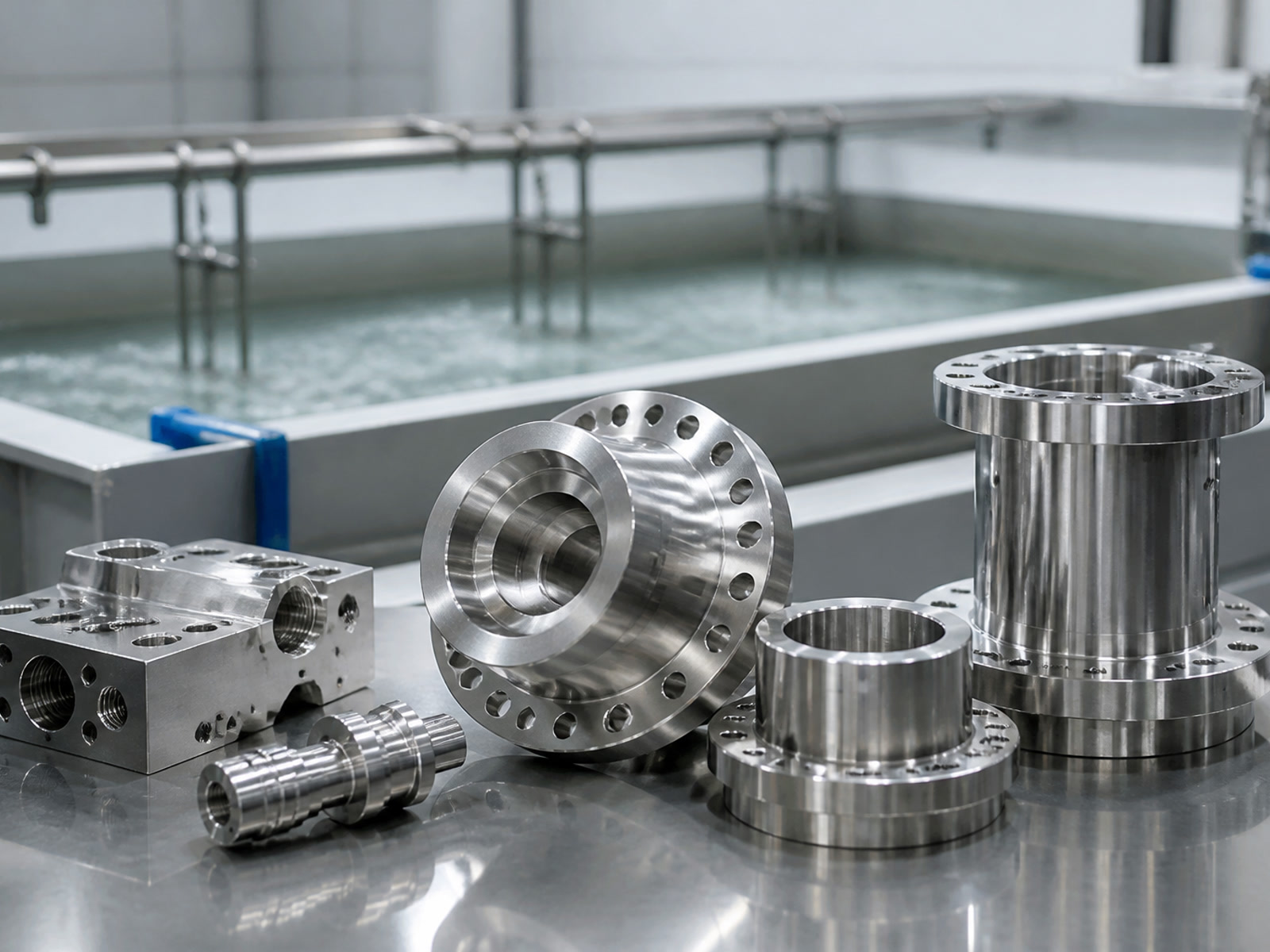
What We Passivate
Passivation is most commonly applied to stainless steels, especially when corrosion resistance and clean surfaces are critical.
Austenitic Stainless Steels
304, 316L, 321
Precipitation-Hardening
17-4 PH, 15-5 PH
High-Temperature Steels
A286
Other difficult alloys can be evaluated case-by-case based on drawing requirements and end-use environment. If your part is made from nickel-based alloys or titanium, we will review the drawing notes and functional intent and propose the correct surface treatment route (passivation vs. other corrosion-control or cleaning requirements).
When to Specify Passivation
Customers typically request passivation when projects include:
Corrosion-sensitive industries: Aerospace, medical devices, semiconductor equipment, energy, oil & gas
Critical geometry: Parts with tight tolerances, sealing interfaces, precision bores, threads, or critical mating features
Compliance needs: Cleanliness, controlled documentation, and traceability requirements
Common Trigger Points
- ✓ Machined stainless parts needing improved resistance to free-iron contamination
- ✓ Components that undergo multiple handling steps (machining → deburr → inspect → assemble)
- ✓ Drawings calling out passivation standards, corrosion resistance, or surface condition requirements
Programs moving from an unreliable supplier, where repeatability and inspection evidence matter.
Our Approach: Passivation Integrated with Machining & Quality Control
AXALLOY’s strength is not only performing passivation, but managing it as part of a complete, controlled manufacturing route.
Engineering Review Before Processing
- • Material behavior and condition (e.g., PH stainless state)
- • Geometry and critical interfaces
- • Tolerances and surface finish targets
- • Areas requiring masking or protection
- • Inspection strategy and documentation needs
Process Planning to Protect Critical Features
- • Minimize handling steps and rework loops
- • Confirm deburring method before passivation
- • Align cleaning, marking, and packaging steps to avoid re-contamination
Verification and Documentation
- • Certificate of Conformance (CoC)
- • Material Test Report / Mill Test Certificate
- • First Article Inspection Report (FAI)
- • Ballooned drawing + dimensional inspection report
- • Surface roughness report and special process records
Typical Part Types We Support
Passivation is frequently used on components that demand corrosion resistance and surface integrity:
- ✓ Valve parts, nozzles, fittings, connectors
- ✓ Precision housings, brackets, manifolds, plates
- ✓ Shafts, sleeves, bushings with corrosion-sensitive fits
- ✓ Components with thin walls (down to 0.5 mm) or delicate features
- ✓ Parts requiring fewer setups via mill-turn to maintain feature relationships
Quality & Inspection Capability
We support tight-tolerance work and inspection evidence for international customers:
±0.010 mm
Standard Tolerance
±0.005 mm
Precision Tolerance
0.005 mm
Flatness (grinding to 0.003 mm)
0.008 mm
Concentricity
Surface finish: Ra 1.6 μm typical, Ra 0.8 μm precision, grinding to Ra 0.2 μm
CMM range: 700 × 1,000 × 600 mm
Temperature-controlled inspection environment • In-process + final inspection available
Best-Fit Customers for Passivation Programs
AXALLOY is a strong fit if you value:
- ✓ Clear DFM/tolerance feedback from engineering
- ✓ Stable production routing for repeat builds
- ✓ Export-ready documentation and traceability
- ✓ Reliable lead times and communication across time zones
Typical Decision-Makers We Support
Lead Time & Production Volumes
1
MOQ (part)
5–10
Prototype Lead Time (business days)
10–20
Standard Lead Time (business days)
1–10,000+
Supported Volumes (parts)
Expedited service available (project-dependent).
RFQ Checklist for Fast, Accurate Quoting
To quote machining + passivation efficiently, please include:
- • 2D drawing (PDF/DWG/DXF) with passivation callouts/notes
- • 3D model (STEP/STP/IGES/X_T/SAT/SolidWorks)
- • Material grade and condition (e.g., 316L, 17-4 PH state)
- • Quantity and expected repeat demand
- • Defined critical features and inspection requirements
- • Required certifications (FAI, full dimensional, MTR, special process records)
- • Target delivery date
Supported upload formats: STEP, STP, IGES, IGS, X_T, X_B, SLDPRT, SAT; PDF, DWG, DXF
Max RFQ upload size: 500 MB
Request a Quote: CNC Machining + Passivation
Send your drawings/models and requirements, and AXALLOY Precision will respond with:
Manufacturability feedback (DFM)
A controlled machining + passivation process route
Clear inspection and documentation plan aligned to your quality requirements
If your drawing specifies a particular passivation standard, include it in the RFQ notes so we can align processing and deliver the correct compliance documentation.
Request a Quote
Tell us about your component requirements and material challenges.